Mean Square Displacement
The mean square displacement measures translational motion over a lag time [Allen2017]. For Cartesian component \(\alpha\), PQAnalysis averages over multiple time origins [Rahman1964] according to
Coordinates are unwrapped with the periodic cell before displacements are accumulated. In an isotropic diffusive regime the Einstein relation [Einstein1905] links the long-time slope to the self-diffusion coefficient,
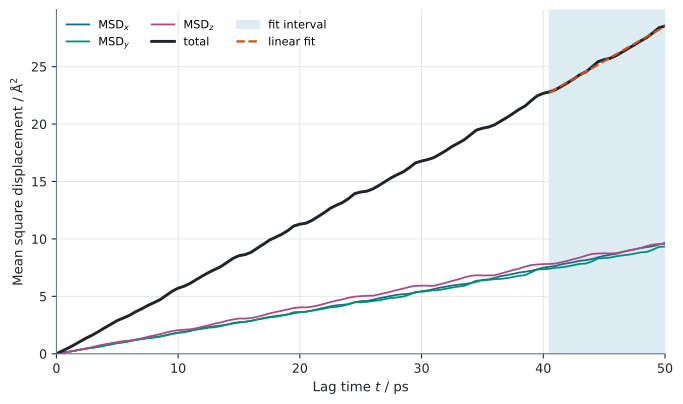
and each Cartesian component is fitted with the one-dimensional factor \(\tfrac{1}{2}\). Below, the bundled oxygen-atom fixture is plotted with an assumed 0.5 ps frame interval; the dashed line fits the last 20 total-MSD points.
Input
traj_files = trajectory.xyz
target_selection = O
out_file = msd.dat
window = 1000
gap = 10
time_step = 0.001
fit_window = 200
Saved as msd.in, it runs with:
$ pqanalysis msd msd.in
window is the largest lag in frames and must be divisible by gap, the
spacing between time origins. time_step in ps enables the diffusion fit;
fit_window is the number of trailing points it uses (default
max(2, window // 5)). The bundled Example data fixture uses window = 8
because it has only 25 frames. The full key table is on
MSDInputFileReader.
Output
out_file holds the lag index and the x, y and z components in Ų; their
sum is the total MSD (MSD). Diffusion coefficients,
their standard errors and \(R^2\) go to the log file in m²·s⁻¹.
Python
from PQAnalysis.analysis import MSD
from PQAnalysis.io import TrajectoryReader

analysis = MSD(
    TrajectoryReader("examples/water/trajectory.xyz"),
    target_species="O",
    window=8,
    gap=2,
    time_step=0.001,
    fit_window=4,
)
lags, msd_x, msd_y, msd_z, msd_tot = analysis.run()
print(analysis.fit_results)  # D components in m²·s⁻¹ when time_step is set
msd() runs an input file instead.
Before you trust it
Fit only where the MSD is linear in time. A high \(R^2\) on a ballistic or caged segment still yields a finite, meaningless \(D\).
The fit is anchored at the largest lag. Shrink
fit_windowto skip the short-time regime; shrinkwindowto move away from the noisy tail.Every lag is averaged over
(n_frames - window) // gaporigins. Keep the trajectory much longer thanwindow.The printed uncertainty is a lower bound, and no finite-size (Yeh-Hummer) correction is applied.
Atoms must not move more than half a box edge between written frames, or unwrapping fails silently.
Each point is derived in MSD: Theory and Validity.