Radial Distribution Function
The radial distribution function measures the probability of finding a target atom at distance \(r\) from a reference atom relative to an ideal gas at the same effective target density [Hansen2013]. For histogram bin \(i\), PQAnalysis uses the standard simulation estimator [Allen2017],
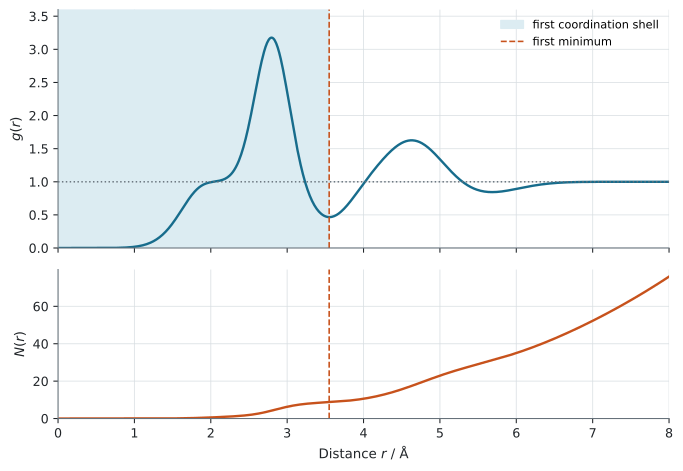
where \(H_i\) is the eligible pair count, \(\rho_T\) the target number density, \(N_R\) the number of reference atoms, \(N_F\) the number of frames and \(\Delta V_i\) the spherical-shell volume. Peaks mark preferred pair separations, minima separate coordination shells, and \(g(r) \approx 1\) is uncorrelated bulk-like pair density. The analytic schematic below (not simulation output) shades the first coordination shell up to the first minimum; the lower panel is the running coordination number \(N(r) = 4\pi\rho\int_0^r g(s)\,s^2\,\mathrm{d}s\) for \(\rho = 0.0334\) Å⁻³.
Input
traj_files = trajectory.xyz
reference_selection = O
target_selection = H
delta_r = 0.05
r_max = 8.0
out_file = rdf.dat
Saved as rdf.in, it runs with:
$ pqanalysis rdf rdf.in
The keys above are typical for a bulk trajectory. The bundled
Example data fixture uses delta_r = 0.5 and r_max = 4.0 because
it is one molecule in a 10 Å box. no_intra_molecular = True drops pairs
inside the same molecule and needs restart_file and moldescriptor_file;
naming both files enables it by itself. PQAnalysis infers the usual PQ
companion filenames when they sit beside the trajectory. Selection strings
are described in Atom selections; the full key table is on
RDFInputFileReader.
Output
out_file has five columns: bin center, \(g(r)\), running coordination
number, shell population and pair-count residual. Exact definitions are in
RDF. The coordination number is read off at the row
where \(g\) has its first minimum.
Python
from PQAnalysis.analysis import RDF
from PQAnalysis.io import TrajectoryReader

r, g, n, shell, residual = RDF(
    TrajectoryReader("examples/water/trajectory.xyz"),
    reference_species="O",
    target_species="H",
    delta_r=0.5,
    r_max=4.0,
).run()
rdf() runs an input file instead.
Before you trust it
r_maxabove half the shortest box edge is clamped; on triclinic cells set it to half the smallest perpendicular width yourself.Bins near the first peak need about \(10^4\) pair counts for 1 % noise. Add frames rather than widening
delta_r.The plateau at large \(r\) should sit at 1. If it does not, look at the volume distribution (NPT) or the selections.
Intramolecular pairs are included unless
no_intra_molecularis on; naming both topology files turns it on.
Each point is derived in RDF: Theory and Validity.