Vibrational Analysis
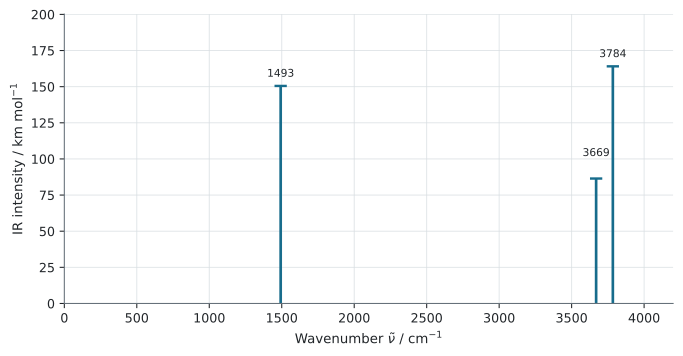
Vibrational analysis diagonalizes the mass-weighted Cartesian Hessian of a single structure [Wilson1955]. Its eigenvectors are the harmonic normal modes; its eigenvalues give signed wavenumbers, force constants and reduced masses. When partial charges are supplied, point-charge infrared intensities are reported as well. The whole calculation is the harmonic approximation applied to one isolated structure: no dynamics, temperature or anharmonicity enters it. The IR stick spectrum below is computed from the bundled H₂O fixture; only internal modes above 100 cm⁻¹ are shown.
Input
structure_file = structure.rst
hessian_file = hessian.dat
out_file = wavenumbers.dat
normal_modes_file = normal_modes.dat
modes_file = modes.xyz
modes = positive
unit = kcal
hessian_sign = auto
Saved as vibrations.in, it runs with:
$ pqanalysis vibrations vibrations.in
structure_file may be a PQ restart or a single-frame XYZ file. unit
names the Hessian energy unit: kcal and ev expect Å⁻², hartree
expects bohr⁻². hessian_sign is positive, negative, 1, -1 or auto
(majority vote over internal curvatures). IR intensities are written only when
a moldescriptor_file supplies partial charges. The bundled
Example data fixture is examples/water; the full key table is on
VibrationalAnalysisInputFileReader.
modes selects which modes reach modes_prefix and modes_file,
compared against modes_threshold \(\theta\) (default
\(10^{-8}\) cm⁻¹):
Value |
Selected modes |
|---|---|
|
Every mode, in order of increasing wavenumber |
|
\(\lvert\tilde{\nu}_j\rvert > \theta\), keeping imaginary modes |
|
\(\tilde{\nu}_j > \theta\), dropping imaginary modes |
Numbers |
Explicit one-based mode numbers: an integer, a list or a range |
Raise modes_threshold to a few cm⁻¹ when the intent is “internal modes
only”; at the default, positive still keeps near-zero translations.
Output
out_file lists wavenumber (negative means imaginary), optional IR
intensity, force constant and reduced mass per mode
(Vibrational analysis). normal_modes_file stores the
dimensionless Cartesian mode matrix, modes_file one extended-XYZ image per
selected mode, and modes_prefix one sinusoidal animation per mode scaled by
modes_amplitude (default 0.25 Å) or modes_temperature.
Python
from PQAnalysis.analysis.vibrational import calculate, read_hessian_file
from PQAnalysis.io import read_restart_file

system = read_restart_file("examples/water/structure.rst")
hessian = read_hessian_file("examples/water/hessian.dat")
result = calculate(
    system.atomic_masses,
    system.pos,
    hessian,
    unit="kcal",
)
print(result.wavenumbers[:10])
print(result.force_constants[:10])
vibrations() runs an input file
instead.
Before you trust it
Expect \(3N\) modes: six external ones (five for linear molecules) near zero, the rest positive at a minimum. Residual external modes of tens of cm⁻¹ mean an unconverged geometry or a noisy Hessian.
A wrong
unitor atom ordering yields a plausible spectrum on the wrong scale without an error. Sethessian_signexplicitly when the producing code’s convention is known.Harmonic wavenumbers exceed observed fundamentals; no scaling factor is applied. Point-charge IR intensities are qualitative.
The external-mode construction assumes an isolated molecule.
Each point is derived in Vibrations: Theory and Validity.